

When you see a professional window cleaner using a water-fed pole system, it can be easy to assume that all systems work in roughly the same way. Water goes up the pole, the windows are brushed and rinsed, and they are left to dry naturally. But behind the scenes, there can be a significant difference in the temperature and purity of the water being used.
At S&E Cleaning Services, we’ve always believed that investing in professional equipment matters. Two areas that can make a real difference are heated pure water and the level to which that water has been purified.
So, what is the difference between hot and cold water window cleaning — and what does it mean when pure water is measured in parts per billion rather than parts per million?
First: How Does Pure Water Window Cleaning Work?
Normal tap water contains dissolved minerals and other impurities. If you wash a window with ordinary tap water and simply allow it to dry, those dissolved minerals can remain behind on the glass, creating spotting or marks.
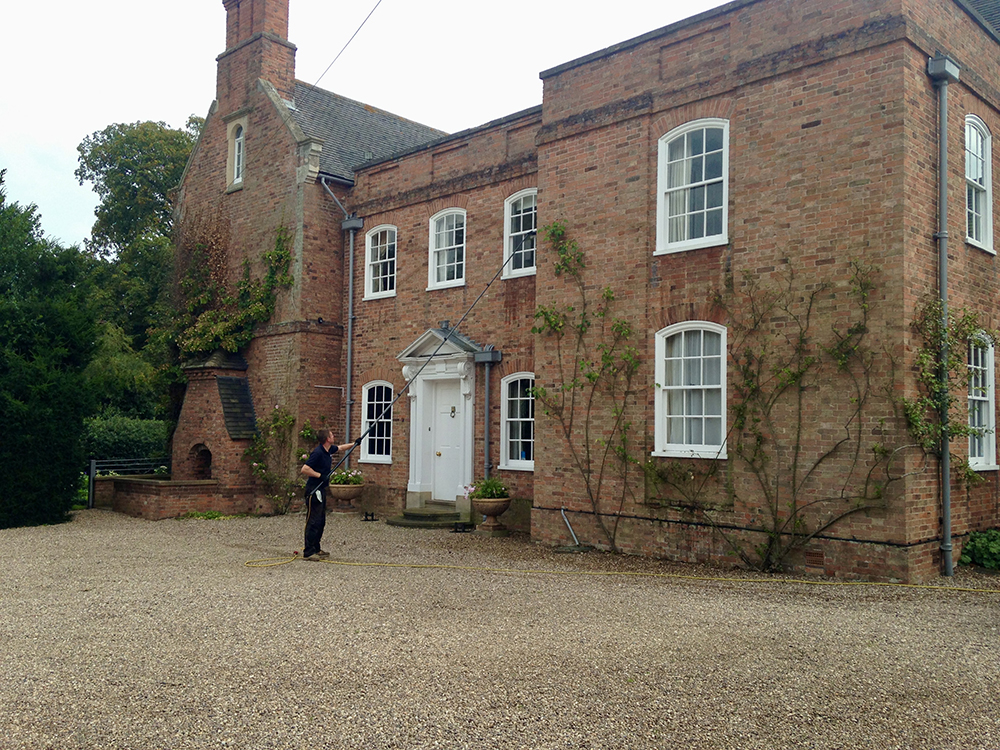
Pure water window cleaning works differently. The water is put through a filtration process that removes these dissolved impurities. The purified water is then pumped through a hose and up a water-fed pole to a specialist brush. The brush is used to agitate dirt from the glass, frames and sills before everything is thoroughly rinsed with pure water. Because the minerals that would normally cause spotting have been removed, the glass can then be left to dry naturally without needing to be squeegeed or dried by hand.
Pure Freedom, one of the specialist manufacturers of professional window-cleaning equipment, explains that purified water can produce a clear, spot-free finish when the glass has been properly agitated and rinsed.
But purity is only one part of the equation.
Hot Water Window Cleaning vs Cold Water Window Cleaning
Cold purified water can clean windows extremely well. In fact, thousands of professional window cleaners use cold pure-water systems every day and achieve excellent results. So we certainly wouldn’t suggest that cold water doesn’t work.
The difference is that heating purified water can give the cleaner another advantage, particularly when dealing with difficult contamination. Think about washing something greasy at home. Cold water will eventually remove it with enough agitation, but warm water generally makes the process easier. The same principle can be useful when cleaning exterior glass.
Professional heated systems can make it easier to tackle things such as:
- Traffic film
- Greasy residue
- Bird mess
- Insect marks
- Pollen
- General atmospheric contamination
- Heavily soiled frames and sills
- Windows that haven’t been professionally cleaned for a long time
Ionic Systems, one of the major manufacturers of professional Reach & Wash equipment, describes heated pure water as more effective at dealing with stubborn contamination and says it can achieve the required result faster and with less effort than cold water in difficult situations.
This can be particularly useful on a first clean. When we take on a new property, we’re often dealing with months, sometimes years, of accumulated dirt around frames, seals, vents, sills and glass. That is why a thorough first clean involves considerably more than simply giving the glass a quick brush and rinse.

Why Hot Pure Water Can Help
Better performance on stubborn contamination
Heated water can help loosen contamination that would require more agitation with cold water. That doesn’t mean the windows are simply sprayed with hot water and magically become clean. The cleaning technique still matters. The brush needs to physically agitate the dirt, and the window then needs to be rinsed properly. But heated purified water gives our operators another tool to help break down stubborn contamination efficiently.
Particularly useful for first cleans
Regularly maintained windows are generally easier to clean than windows that haven’t been cleaned for a long time. A first clean can involve significant amounts of accumulated dirt around:
- Frames
- Sills
- Window seals
- Trickle vents
- Conservatory glass
- Doors
- Difficult corners
Using heated pure water can make this initial restoration clean more effective. Once the property has been brought up to our standard, regular maintenance cleans help keep it there.
Improved winter operation
Heated systems also have practical benefits during colder weather. Professional hot-water systems help keep hoses more flexible and can make equipment easier for window cleaners to handle in low temperatures. Of course, professional window cleaners must still assess weather conditions appropriately, heated water doesn’t make it safe or sensible to clean in every freezing-weather situation.
But Temperature Is Only Half the Story
This is where things get particularly interesting. Most people within the window-cleaning industry are familiar with measuring pure water in parts per million – ppm. A TDS meter, Total Dissolved Solids meter, is commonly used to indicate how many dissolved substances remain within the water. Ordinary tap water can contain hundreds of parts per million of dissolved solids, depending on the water supply and whether you live in a hard or soft water area. After professional purification, window cleaners traditionally aim for a reading around 0 ppm.
But there’s another level.
PPM vs PPB: What’s the Difference?
- PPM stands for: Parts Per Million
- PPB stands for: Parts Per Billion
One part per million represents one part of something within one million parts. One part per billion represents one part within one billion. That means measuring at ppb level provides approximately 1,000 times finer resolution than measuring at ppm level.
And there’s an important distinction here: When a conventional TDS meter displays 0 ppm, it doesn’t necessarily mean that absolutely nothing remains in the water. It means the concentration is below what that ppm-level measurement is displaying.
Advanced ultra-pure water systems can monitor water purity at a much finer level. Ionic Systems, for example, developed its Zero system around water quality measured at 0 ppb, rather than the traditional industry benchmark of 0 ppm.
Why Does Ultra-Pure Water Matter When Cleaning Glass?
The principle behind pure-water cleaning is simple: Remove the minerals and impurities from the water and you create water that is extremely effective for rinsing cleaned surfaces without leaving mineral residue behind. The cleaner the rinse water, the less dissolved material is being introduced back onto the glass.
This is especially valuable when you’re trying to produce a consistently clear finish across large amounts of glazing. It is also why we don’t add conventional window-cleaning detergent to the final pure-water rinse. We want the water hitting the glass to be extremely clean.
Professional laboratory water standards also use conductivity and resistivity to distinguish extremely high levels of water purity, illustrating just how significant very small concentrations of ions become once water reaches ultra-pure levels. (Thermo Fisher Documents)
Does PPB Water Mean Windows Are 1,000 Times Cleaner?
No, and we think it’s important to be clear about that. Although ppb measurement is 1,000 times finer than ppm measurement, it would be misleading to tell a homeowner that their windows will therefore be “1,000 times cleaner.”
There are many other factors involved in producing a great finish: Equipment. Technique. Brush quality. Water flow. Agitation. Rinsing. Operator experience and water purity.
Ultra-pure water is one part of that complete cleaning system. The important point is that it allows us to work with water that has been purified and monitored to an exceptionally high standard.
Why Professional Equipment Matters
There can be a huge difference between simply owning a water-fed pole and operating a genuinely professional pure-water window-cleaning system.
At S&E Cleaning Services, we invest heavily in the equipment our team uses because it affects both the quality of the clean and the way the job can be carried out. Our water-fed pole systems also allow us to clean much of a property’s exterior glazing safely from ground level, including areas that would traditionally have required repeated ladder access.
For our customers, that means the combination of:
- Professional water purification
- Heated water when appropriate
- Specialist water-fed brushes
- Thorough agitation of the glass, frames and sills
- A proper pure-water rinse
- Reduced reliance on ladders
- Experienced, trained operators
- Regularly maintained professional equipment
It’s the complete process that produces the result.
Is Hot Water Always Better Than Cold Water?
Hot water has advantages, but that doesn’t mean every window requires high-temperature cleaning. On well-maintained windows with light contamination, cold purified water can produce an excellent finish.
The advantage of having a heated system is that our team can use the additional cleaning power when conditions call for it. It is particularly valuable when tackling stubborn contamination or carrying out thorough initial cleans. In other words, we’re not relying on hot water to compensate for poor technique. We’re combining good technique with better equipment.
The S&E Approach to Window Cleaning
For us, professional window cleaning isn’t about getting around a property as quickly as possible. It’s about building a system that produces consistent results month after month. That’s why our regular window cleaning service isn’t just focused on the centre of the glass. We clean the glass, frames and sills, thoroughly agitate contamination and rinse everything with purified water before allowing it to dry naturally.
And when we take on a new customer, the first clean is deliberately more thorough so that we can get the windows and surrounding framework into the condition we want before beginning regular maintenance.
Hot Water + Ultra-Pure Water + The Right Technique
Ultimately, there’s no single piece of equipment that makes somebody a good window cleaner. But equipment matters. Cold pure water can achieve excellent results. Heated pure water can make difficult cleaning easier. And taking water purity beyond conventional ppm measurement into ultra-pure ppb territory demonstrates just how far professional window-cleaning technology has progressed.
Combine that with the right brushes, good technique, sufficient rinse water and experienced operators, and you have an incredibly effective way of maintaining modern homes and commercial buildings.
Looking for professional window cleaning?
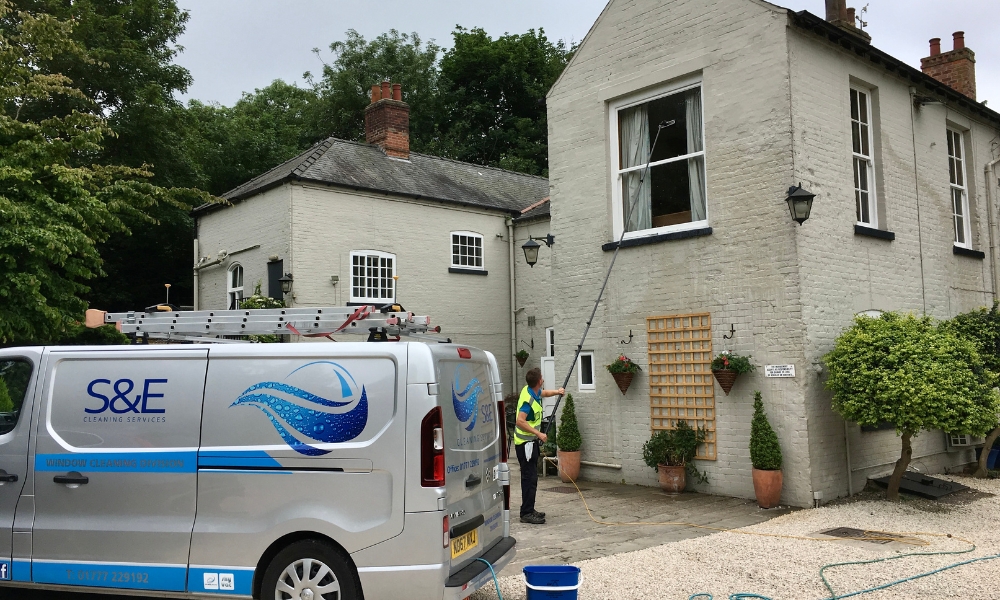
S&E Cleaning Services provides professional residential and commercial window cleaning throughout Retford, Worksop, Gainsborough, Newark and the surrounding villages.
If you’re looking for a reliable regular window-cleaning service using modern professional equipment and properly purified water, we’d be happy to help.